Independent Schools Queensland · Professional learning
Professional learning for teachers, about teaching.
A sixty-minute course on differentiating the educational program for students in Years 7 to 10. The audience are practising secondary teachers, which sets a high bar: anything that reads as theory they already know loses them immediately.
01

In 60 seconds
- The problem
- Differentiation is a concept most secondary teachers can define and fewer have a repeatable method for.
- My role
- Learning design and development. Editorial placeholder: Confirm role boundaries and subject-matter collaborators
- Scope
- Instructional design, scenario writing, interaction design and course build.
- Where it got to
- A sixty-minute self-paced course for teachers in ISQ member schools. Editorial placeholder: Add measurable outcome
- Built with
- Articulate Storyline
The situation
The learners here are practising teachers, and the subject is their own practice. That is the hardest audience configuration in professional learning, because the participant can tell within thirty seconds whether the designer has been in a classroom.
The recovered sequence shows the course dealing with that directly: it establishes the problem in the language of the classroom, gives one model, and then spends most of its length inside a single worked example.
What was actually wrong
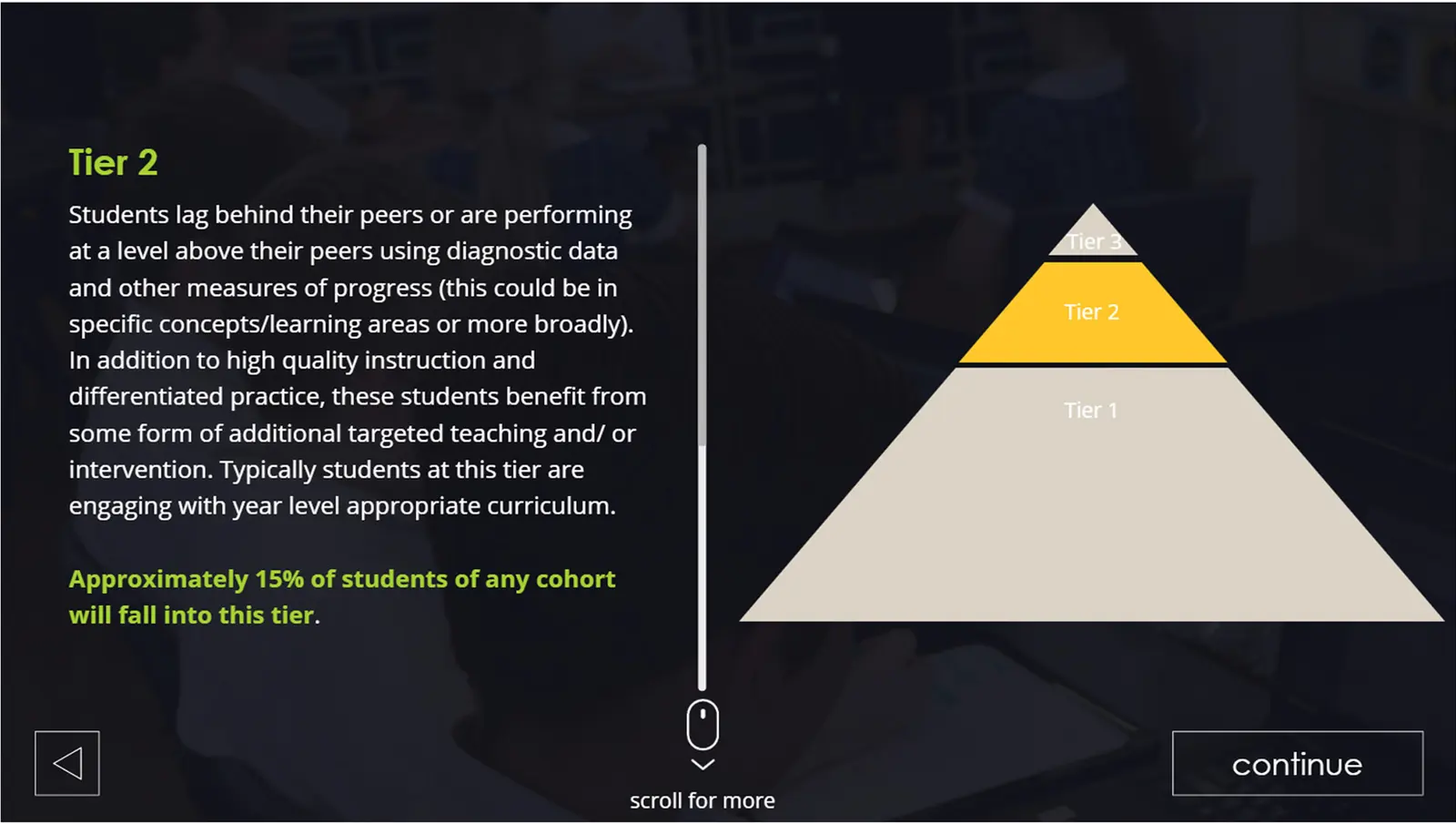
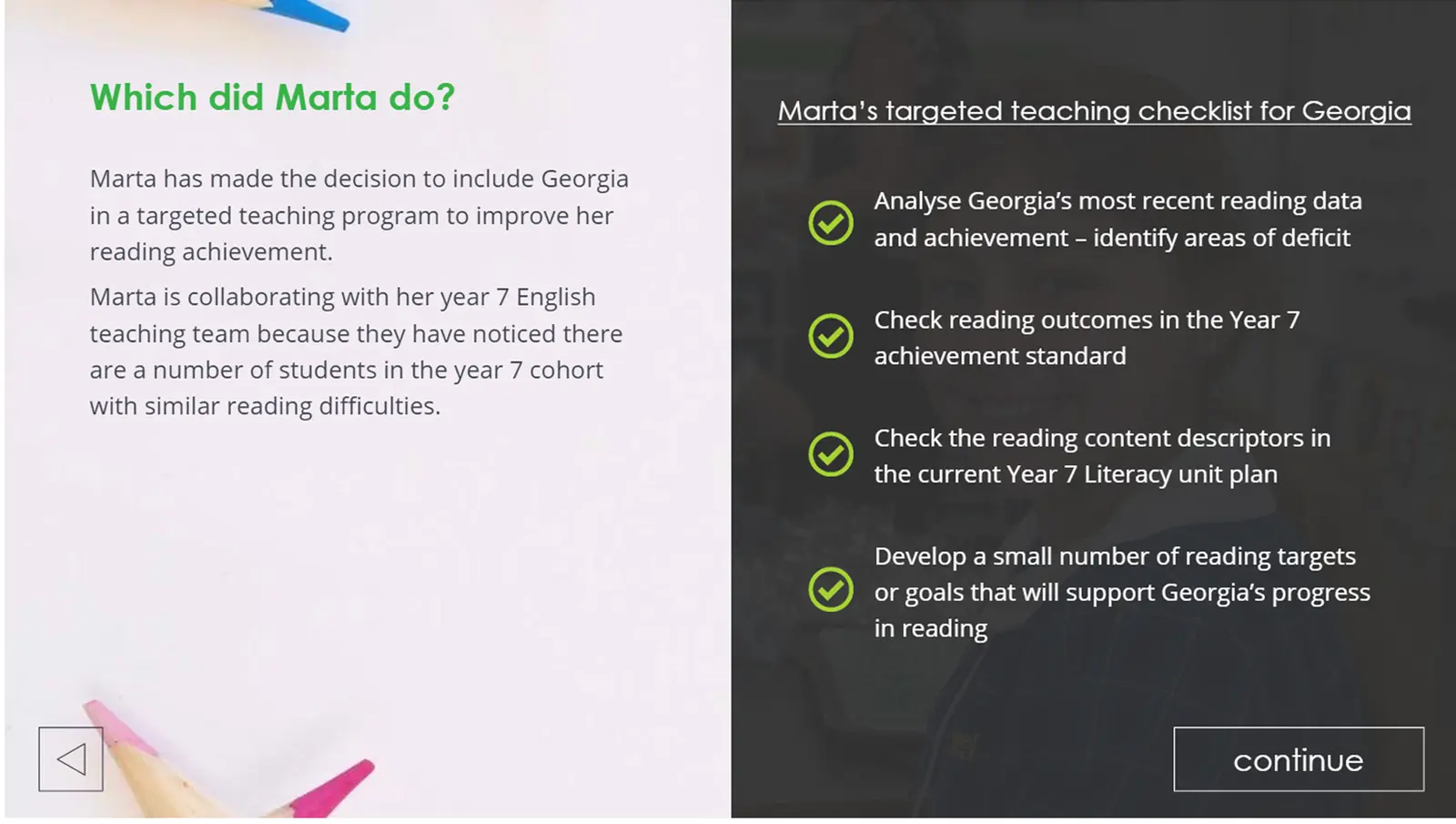
A course about differentiation could reasonably be organised around the tiers of intervention, because that is how the literature is organised. The recovered sequence does not do that. It introduces the tiers once, then switches to a named teacher making a decision about a named student.
That is the substantive design decision. A model tells a teacher what category a student is in. A worked example shows what the teacher does on Monday, which is the actual gap.
What it looked like, and why
02Content design

03Content design
04Content design
05Learning experience
Key design decisions
Spend the length on one worked example
- The choice
- The tier model is introduced once; the majority of the sequence follows a single teacher and student.
- Why
- Practising teachers can already categorise students. What they lack is a repeatable next action, and a worked example carries that better than a framework does.
Quantify the model
- The choice
- The tier explanation names the proportion of a cohort it applies to.
- Why
- A percentage lets a teacher map the model onto the class in front of them. A diagram alone does not.
Source the framework on screen
- The choice
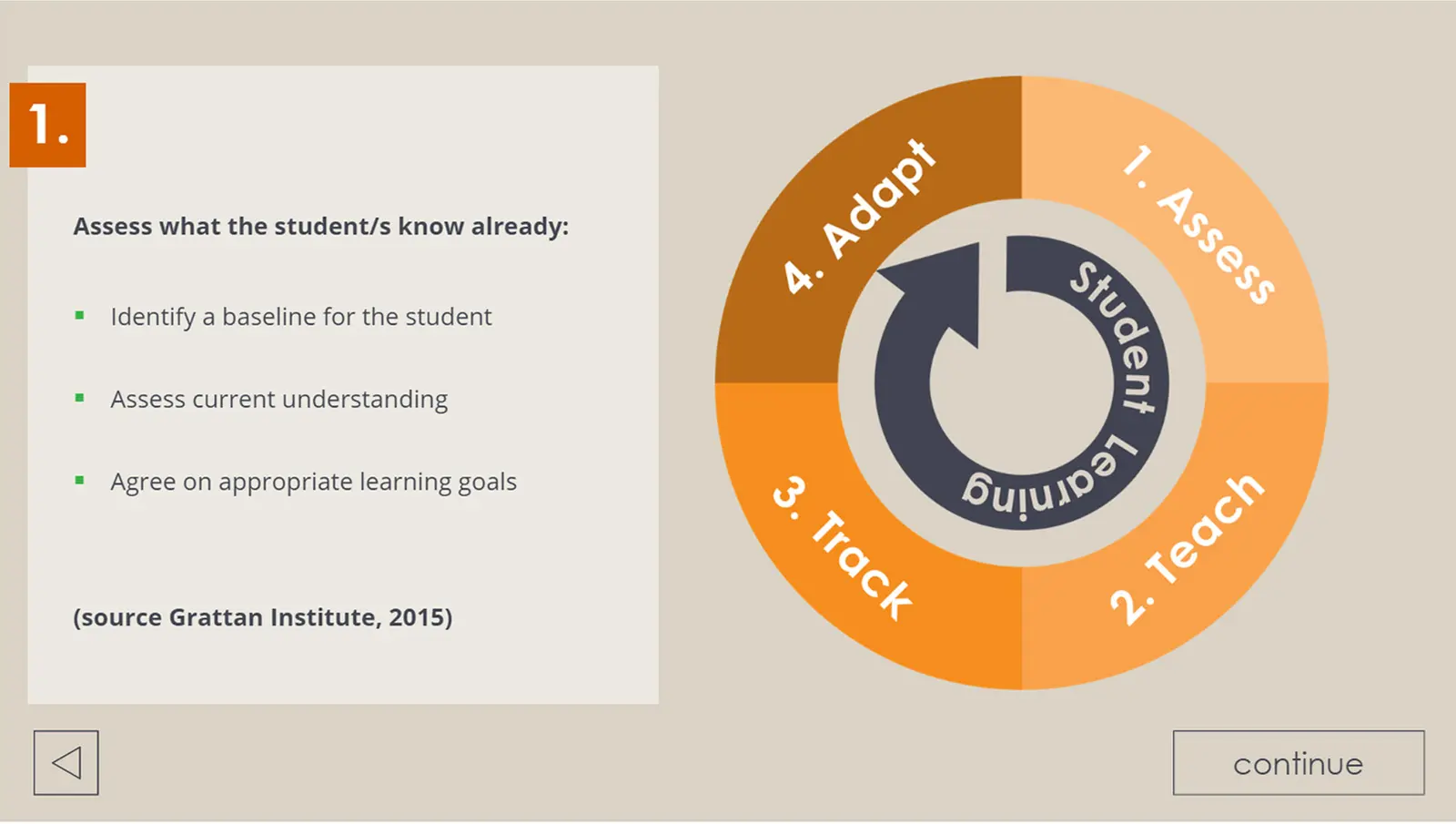
- The assess, teach, track and adapt cycle carries its citation in the frame.
- Why
- This audience evaluates the provenance of an approach before they evaluate the approach.
Where it got to
- A sixty-minute self-paced professional learning course for secondary teachers
- A scenario-led structure built on one worked classroom example
- Editorial placeholder: Add measurable outcome
- Editorial placeholder: Confirm number of courses/users
Completion, evaluation and impact data for this course has not been supplied, and none is claimed.