Sonic HealthPlus · Occupational health
Teaching a service offering as a learning experience.
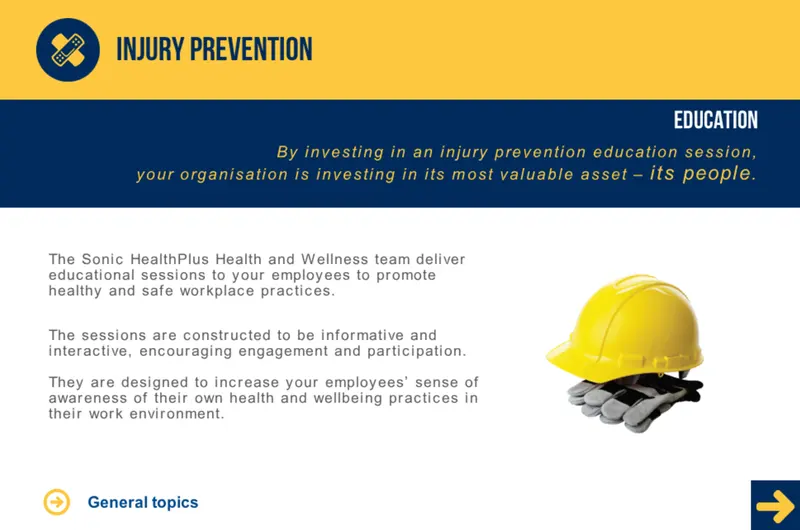
A course suite covering injury prevention, treatment and management for an occupational health provider. The subject is a commercial service model, which is a harder learning design problem than it sounds: the content is inherently a list, and a list is not a course.
01

In 60 seconds
- The problem
- A service model with tiers, inclusions and exclusions, which people were expected to know and could only learn from a brochure.
- My role
- eLearning design and development. Editorial placeholder: Confirm role boundaries
- Scope
- Learning design, visual system, interaction and assessment design, and course build across a suite of modules.
- Where it got to
- A branded course suite on one visual system. Editorial placeholder: Add measurable outcome
- Built with
- Articulate Storyline
The situation
The content here is a commercial service model: tiers, retainers, what is included, what is charged for, and which service applies when. That kind of material is normally distributed as a document, and normally not read.
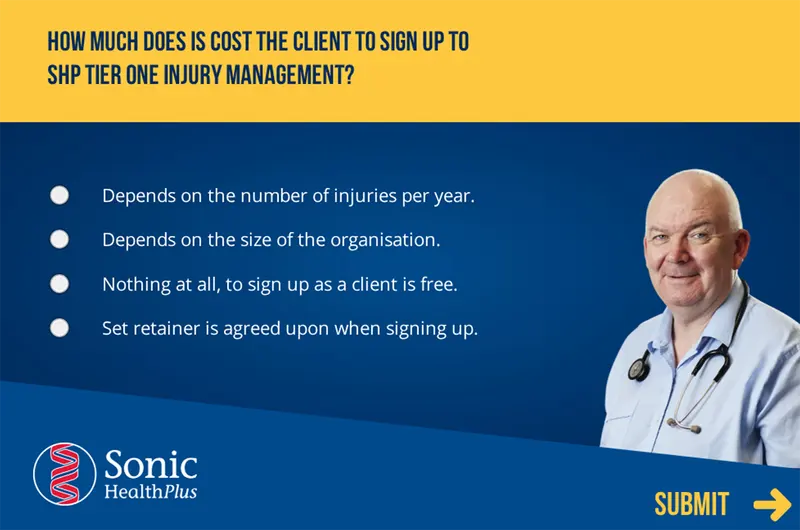
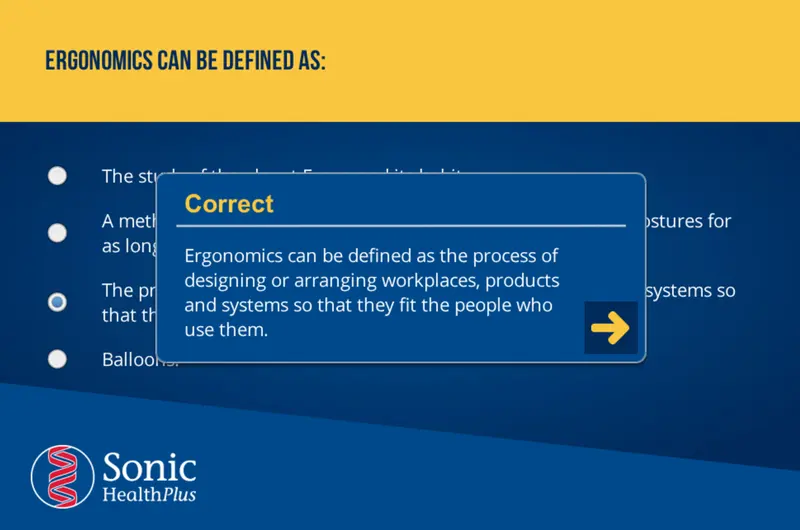
The recovered screens show it treated as learning instead, with the service distinctions taught through questions rather than stated in a list.
What was actually wrong
The temptation with service content is to explain the model and then test recall of it. That produces a quiz about a brochure.
What the recovered assessment screens actually do is put the learner in the position of answering a client's question, then correct the answer with the reasoning attached. The distinction is small on screen and large in effect: the learner practises the judgement rather than memorising the tier table.
What it looked like, and why
02Design systems

03Learning experience
04Content design
Where it got to
- A course suite covering injury prevention, treatment and management
- A reusable visual template applied consistently across modules
- Question-and-feedback interactions carrying reasoning rather than confirmation
- Editorial placeholder: Add measurable outcome
- Editorial placeholder: Confirm number of courses/users
No completion, evaluation or commercial outcome data has been supplied for this project, and none is claimed.