CASA program · Structure
Structuring a role-based learning catalogue.
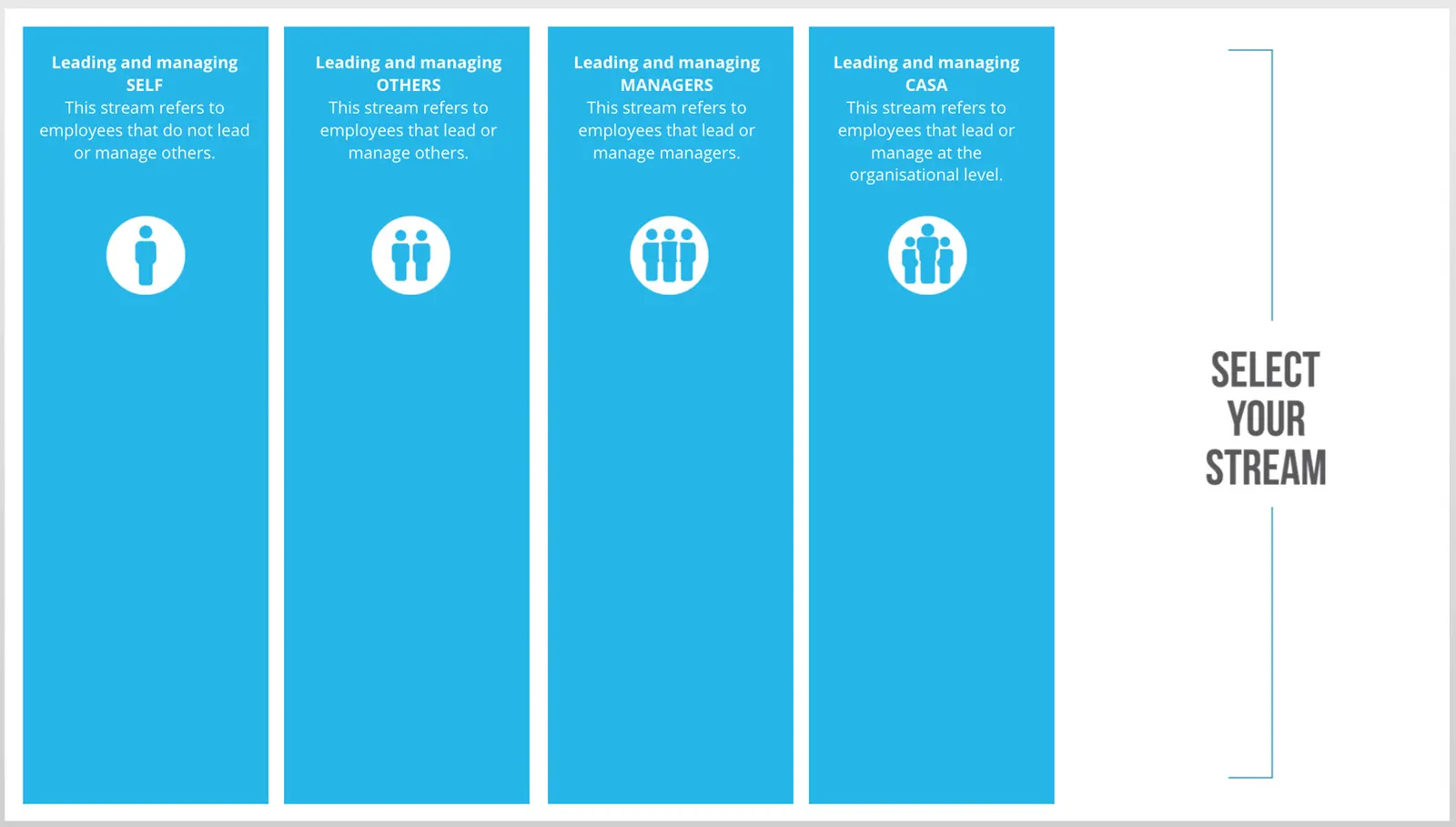
When learning is role-specific, the hardest interface problem is the first screen. This one asks a single question a person can answer about themselves, and uses the answer to do the filtering.
01Information architecture
In 60 seconds
- The problem
- A large body of learning that is only relevant to some people, presented to everyone.
- My role
- Information architecture and interface design for the catalogue entry.
- Scope
- Audience segmentation, stream definitions, entry-point design and catalogue navigation. Editorial placeholder: Confirm platform scope
- Where it got to
- A stream-based catalogue entry. Editorial placeholder: Add measurable outcome
- Built with
- Articulate Storyline · Editorial placeholder: Confirm hosting platform
The situation
Role-specific learning creates a filtering problem, and most catalogues solve it badly. Either everything is shown and most of it is irrelevant, or the filtering depends on data in a staff record that is out of date.
The recovered evidence shows CASA using a third approach: ask the learner one question they can answer about themselves, and use the answer as the filter.
What was actually wrong
The four streams are not levels of seniority. They are spans of responsibility: leading yourself, leading others, leading managers, leading the organisation. That distinction matters, because it lets a technical specialist with no direct reports and a new team leader arrive at different content without either being told they are junior.
It also means the taxonomy survives a restructure. Job titles change; the question of how many layers of people you are responsible for does not.
What it looked like, and why
02Learning experience
Where it got to
- A single-question entry point that filters a large body of role-specific learning without relying on stale staff-record data
- A four-stream taxonomy built on span of responsibility rather than job title, so it survives a restructure without being redefined
- Editorial placeholder: Confirm how many courses sat behind each stream and how the catalogue was maintained
Catalogue size, course counts and platform adoption are unconfirmed and not claimed here.